
When you spend money on a silk or satin garment, you are making a purchasing decision based almost entirely on how the fabric looks and feels in a brief moment of handling. What is silk momme weight, and why does it matter to that decision? Momme weight is the single most reliable indicator of silk fabric quality — more informative than price alone, more specific than terms like premium or luxury grade, and measurable enough to compare across garments and brands. Understanding it changes the way you shop for silk, satin, and related woven fabrics. This guide explains the technical definition, how to read the numbers, and what the differences between common momme weights mean in practice for garment lifespan, drape, and care requirements.
The Definition of Momme Weight
Momme (pronounced moh-mee) is a unit of weight used to measure the density of silk fabric. The formal definition is: the weight in pounds of a piece of silk measuring 45 inches wide by 100 yards long. If that standardised piece of silk weighs 19 pounds, the fabric is 19 momme. If it weighs 22 pounds, it is 22 momme.
The momme system was developed in Japan as part of a standardised grading framework for silk production, and it has remained the industry reference measure for silk density because it captures something thread count does not: the actual mass of material in the fabric. A heavier momme weight means more silk threads per inch — not just more threads, but more silk per thread, resulting in a denser, more durable weave structure.
In practical terms, higher momme weight produces a fabric that is less sheer, more resistant to snagging and tearing, more resistant to the shiny wear patterns that develop at high-friction points like armholes and cuffs, and more capable of holding a structured silhouette over time. It also drapes with more body — not stiffly, but with a deliberate, weighted fall that lighter-weight silk cannot replicate.
Most commercial silk garments in the accessible luxury segment range from 16 to 22 momme. Garments positioned as high-end or investment quality generally begin at 19 momme, with the most durable and opaque options reaching 25 momme and above.
Why Momme Weight Is the Most Reliable Silk Quality Indicator
Thread count has conditioned many consumers to look for a single number as a quality shorthand, but thread count measures quantity of threads — not the quality of those threads or how tightly and densely they are woven together. A fabric can have a high thread count and still be thin, weak, and prone to pilling if the individual threads are fine or the weave structure is loose.
Momme weight sidesteps this problem by measuring mass directly. You cannot inflate a momme weight number through manufacturing shortcuts the way thread count can be inflated by using thinner threads in a tighter, more tangled weave. For this reason, fabric researchers and independent certification bodies — including the Textile Exchange Integrity Program — treat fiber weight per standardised area as a more honest indicator of fabric quality than thread count alone.
“Momme weight is one of the few silk quality metrics that is genuinely difficult to manipulate. You are measuring the physical mass of the material, not a count that can be gamed by weave construction. For consumers trying to make an informed comparison between two silk garments, asking for the momme weight is a far more reliable question than asking about thread count or grade designation.”
— Dr. Eleanor Marsh, textile scientist, University of Leeds
The implication for shopping is direct: when a retailer or brand cannot or will not specify the momme weight of a silk garment, that absence of information is itself informative.
The Momme Weight Comparison: 19 vs 22 vs 25
The three most commonly encountered momme weights in quality silk garments are 19, 22, and 25. Each occupies a distinct position in terms of the garment physical properties and expected lifespan.
| Property | 19 Momme | 22 Momme | 25 Momme |
|---|---|---|---|
| Weight per yard | Light-medium | Medium | Medium-heavy |
| Opacity | Semi-sheer | Mostly opaque | Fully opaque |
| Drape quality | Fluid | Structured fluid | Structured |
| Durability | Good | Very good | Excellent |
| Best use | Blouses, scarves | Dresses, gowns | Luxury gowns, bedding |
| Care sensitivity | Very high | Medium | Medium |
| Garment lifespan | 3–5 years | 5–10 years | 10+ years |
At 19 momme, a silk garment sits at the lower boundary of what most quality-focused retailers would consider investment grade. It is light, fluid, and beautiful — ideal for blouses and scarves where drape is more important than opacity or durability. A 19 momme blouse worn regularly will begin to show wear at friction points within two to three years of consistent use. It requires careful handling: cool water, no enzyme detergents, and no machine washing under any circumstances.
At 22 momme, the fabric crosses into what most experienced buyers consider the baseline for a garment intended to last five years or more. The added density produces a fabric that is mostly opaque without a lining, holds its shape better at seams and hems, and is significantly more resistant to the wear patterns that age lighter-weight silk prematurely. A 22 momme dress or gown can function as a genuine long-term wardrobe piece if cared for correctly. This is the momme weight most commonly used in quality occasion dresses and formal gowns in the accessible luxury segment.
At 25 momme and above, silk enters its highest practical weight range for garment use. The fabric is fully opaque, holds a structured silhouette without internal supports, and resists snagging and tearing at a level that makes decade-long use realistic. Care requirements remain demanding relative to synthetic alternatives, but the fabric is noticeably more forgiving than 19 momme silk under the same conditions. Garments at this weight are typically reserved for luxury gowns, bridal wear, and high-end bedding, where the weight of the fabric is part of the intended sensory experience.

How Satin Weave Relates to Momme Weight
A common source of confusion in fabric discussions is the relationship between satin and silk. Satin is not a fiber — it is a weave structure. Specifically, satin is characterised by a four-over-one-under interlacing pattern, where each weft thread passes over four warp threads before going under one. This weave structure produces the smooth, reflective surface associated with satin because the long floating threads on the surface catch and reflect light uniformly.
Silk satin is silk fiber woven in a satin weave. Polyester satin is polyester fiber woven in the same weave structure. The visual result can be similar — both will have a surface sheen — but the underlying fiber quality, hand feel, breathability, and longevity are fundamentally different. Momme weight applies to silk satin exactly as it applies to charmeuse or habotai: it measures the density of the silk fiber in the weave, regardless of the weave pattern used.
For garments described as satin without further specification, asking for the momme weight tells you whether you are looking at a lightweight satin with a lifespan of a few seasons or a densely woven satin intended for long-term use. The Silk Association of Great Britain provides reference information on silk fiber classifications and weave types useful for consumers wanting to develop a more detailed understanding of how these variables interact.
When evaluating a satin garment, the weave and the fiber weight work together. A 22 momme silk charmeuse and a 22 momme silk satin will have similar density and durability properties, but the satin weave will produce a higher surface sheen and slightly less fluid drape. Understanding this distinction helps you match the specific physical properties of the fabric to your intended use.
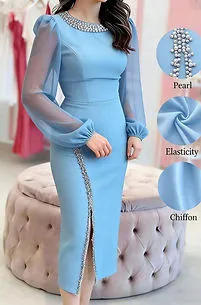

Care Instructions for High-Weight Fabrics
Higher momme weight does not make silk indestructible. Silk remains a protein fiber that responds poorly to enzyme-based detergents, high heat, and mechanical agitation. The difference is that a higher momme weight fabric has more margin — a snag that damages 10 threads in a 19 momme silk damages those threads as a larger proportion of the total fabric than the same snag in a 25 momme weave.
For Silk and High-Weight Satin
- Hand wash in cool water — not cold, not warm. Cool water reduces dye run and prevents the heat-related damage that weakens silk protein bonds.
- Use a pH-neutral detergent formulated for delicate or protein fibers. Standard laundry detergent contains enzymes that actively break down silk protein.
- Never use enzyme detergents, biological detergents, or any product marketed for stain removal on silk or silk satin.
- After washing, roll the garment in a clean dry towel to absorb water. Never wring or twist — wringing stresses the weave and causes permanent distortion at stress points.
- Dry flat on a clean, dry surface away from direct sunlight. Sunlight causes silk to yellow and weakens the fiber over time.
- Iron on the reverse side of the fabric at the lowest temperature setting. Place a pressing cloth between the iron and the fabric for additional protection.
- Store hanging in a breathable garment bag. Folded storage creates permanent crease lines in high-weight silk and satin that can be difficult or impossible to remove without professional pressing.
For Heavily Embellished Garments
- Dry clean only. Embellishments — beading, sequins, applique — are often attached with adhesives or thread tensions that cannot survive immersion in water.
- Between dry cleaning visits, spot clean small marks with a barely damp clean cloth, using minimal pressure and working from the outside of the mark inward.
- Store in a dust bag or breathable garment bag. Embellishments snag on open wardrobe rails and can pull adjacent threads, causing damage that spreads from the point of contact.

How to Verify Fabric Quality When Shopping
Most product descriptions in the accessible luxury segment do not include momme weight as a standard specification. The absence of this information does not automatically indicate low quality, but it does mean you need to ask different questions.
Three questions that produce useful information when evaluating a silk or satin garment:
- What is the momme weight? If the brand or retailer can answer this precisely, it indicates they understand their product at the production level. A vague response about high quality silk is a signal to look more carefully at the physical garment.
- Is the silk content confirmed by certification or country of origin labelling? China, India, and Japan are the primary silk-producing countries with established grading infrastructure. A confirmed origin combined with a stated momme weight is a more reliable quality signal than either piece of information alone.
- What is the fabric composition by percentage? Silk blended with synthetic fibers changes both the momme measurement context and the care requirements. A 60% silk, 40% polyester blend is not equivalent to pure silk at any momme weight.
When handling a garment in person, three signs of lower-quality silk or satin include: a stiff or papery hand rather than a supple one, a surface sheen that looks uniform rather than varied and lustrous, and seam allowances under 1.5 cm that will not support alteration or long-term stress at join points.
The Long-Term View
Understanding what is silk momme weight reframes the price conversation around silk and high-quality satin garments. A 22 momme silk dress at a higher price point is not simply more expensive than a 16 momme alternative — it is a different product with a different expected lifespan, different care requirements, and different physical performance over years of use.
The consumer who understands what they are buying makes a different calculation. The cost-per-wear arithmetic changes materially when a garment that costs twice as much lasts three times as long and maintains its appearance more consistently throughout that period. Investment fabric shopping is not about spending more — it is about spending with enough information to make the expenditure rational. Momme weight is one of the most accessible and specific pieces of information available for making that calculation correctly.