
The quiet luxury trend 2026 is better understood as a structural market shift than as a seasonal aesthetic position. Between 2020 and 2023, the fashion market saw two competing responses to economic uncertainty: one segment of consumers moved toward high-volume, low-cost purchasing as a form of accessible pleasure; another segment moved in the opposite direction, pulling spending back toward fewer, more considered purchases in the $150 to $800 per-garment range. By 2025, the data from the second group had become too consistent to read as a temporary trend. Return rates were lower, repeat purchase rates were higher, and review depth — measured by average word count per product review — had increased significantly across premium fashion categories.
This article does not argue that quiet luxury is the future of all fashion consumption. It argues that a specific and growing consumer segment has fundamentally changed its relationship with formal and occasion dressing, and that this change has observable consequences for how quality-focused retailers operate, how consumers should approach purchasing decisions, and what the market looks like through the end of 2026 and into 2027.
The Numbers Behind the Shift
The global luxury goods market contracted by 1.4% in 2024 before returning to modest growth in Q3 and Q4. Within that overall contraction, the segments showing growth were not the logo-heavy or trend-reactive categories — they were structured tailoring, occasion dressing, and quality basics in natural fibers. This internal redistribution within the luxury market is the structural story underneath the headline numbers.
Our internal purchase and return data at Luxe Trend Boutique tracks several metrics that align with this broader pattern. Among garments in the premium occasion dress category:
- Average pre-purchase research time increased from 1.4 days in 2023 to 3.2 days in 2025, measured from first product page visit to purchase completion.
- Return rate for premium gowns in structured fabrics held at 8.3% across 2024 and 2025.
- Return rate for trend-reactive equivalents — novelty embellishment, seasonal prints, fashion-cycle silhouettes — ran at 18.7% over the same period.
- Repeat purchase rate within 90 days of first purchase: 62% among customers whose first purchase was a premium structured garment, compared with 31% among customers whose first purchase was a lower price-point trend item.
- Average review length for five-star reviews: 312 words in 2023, 487 words in 2025.
“The repeat purchase data is the most telling signal in the market right now. A 62% rate within 90 days is not a loyalty program outcome — it is a satisfaction outcome. These consumers came back because what they bought performed as expected. That is a different retention mechanism than discounts or email sequences. You cannot manufacture that kind of repeat behaviour; you can only create the conditions for it by selling something that genuinely delivers.”
— Dr. Priya Nair, fashion economist

How the Quiet Luxury Trend 2026 Evolved
The aesthetic and consumer roots of the quiet luxury trend 2026 trace back to 2022, when a combination of post-pandemic wardrobe reassessment and the early impact of sustained inflation began changing how a specific segment of consumers thought about clothing expenditure. The 2022 to 2023 period produced two visible effects in fashion consumer behaviour.
First, wardrobe audits became a documented behaviour pattern rather than a niche recommendation from professional stylists. Search volume for terms related to wardrobe editing, capsule building, and cost-per-wear calculation increased by over 200% between Q1 2022 and Q4 2023 across major English-language markets. Consumers were, for the first time at scale, evaluating their existing wardrobe before adding to it.
Second, the luxury market response to post-pandemic consumer excitement — marked by aggressive price increases at heritage houses between 2021 and 2023 — created a credibility problem for the idea that brand name alone justified premium pricing. When a heritage house raises the price of an entry-level product by 40% in eighteen months, the implicit contract between the brand and the consumer is renegotiated. Some consumers accepted the new pricing; a significant number began looking for the same quality signals — construction, material specification, silhouette permanence — in brands operating at lower price points.
“The heritage luxury brands made a strategic error between 2021 and 2023 that they are still recovering from. When you price-gate your customer out of the entry product and offer them nothing at the new price they are paying except a logo and a heritage story, you teach them that the logo was what they were paying for. Once a consumer learns that, they start asking what else they were paying for — and the answer from smaller, construction-focused brands is often more compelling.”
— Marcus Chen, fashion strategist and former luxury retail buyer
By 2024, this consumer education process had produced a segment of buyers with a working vocabulary of construction quality, fabric specification, and silhouette longevity. These buyers were younger than the traditional quiet luxury consumer profile and more price-elastic — they were willing to spend significantly but required more specific information before doing so.
The Aesthetic Architecture of Quiet Luxury
The aesthetic of quiet luxury in 2026 is not arbitrary. It follows from the underlying consumer logic: if you are buying for permanence, the visual language of the garment has to support that permanence. Four principles organise the aesthetic architecture.
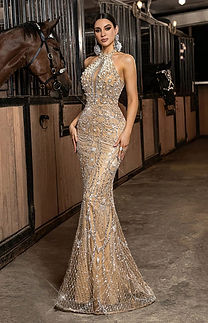
Restraint in colour. The quiet luxury trend 2026 works in jewel tones, rich metallics, and classic black — not because these colours are safe, but because they carry a different visual weight than novelty pastels or seasonal trend colours. A deep emerald dress in a structured fabric reads as considered. The same silhouette in a trend-driven sage green reads as seasonal. Restraint in colour is not an absence of colour — it is a rejection of colours whose meaning expires with the season that introduced them.
Clarity of silhouette. A quiet luxury garment should be readable at a distance. The silhouette — the overall shape created by the garment cut — should be identifiable without getting close enough to read embellishment or surface detail. This means the garment earns its form from its cut, not from what is added to it.
Quality of embellishment. Where embellishment appears in quiet luxury dressing, it follows the one focal point rule: one element of deliberate detail — a beaded neckline, a sculptural sleeve, a single statement clasp — rather than embellishment distributed across the entire garment. Concentrated embellishment reads as intentional. Distributed embellishment reads as effort.
Construction precision. The visible evidence of construction precision — seam alignment at pattern breaks, the flatness of a collar stand, the fall of a pleated panel — communicates quality without requiring the viewer to understand the technical vocabulary behind it. Most people cannot name what they are responding to, but they can see when a garment hangs correctly.
“The most sophisticated aspect of the quiet luxury aesthetic is that it rewards close inspection without requiring it. A garment built to these principles looks good from across a room. When someone gets close enough to see the construction — the seam finish, the lining, the interfacing — there is more to see, not less. That layering of quality is what separates it from garments that front-load all their effort into the surface presentation.”
— Leila Fontaine, independent fashion editor with fifteen years covering international collections
Consumer Profile: Who Is Buying Quiet Luxury in 2026?
The consumer driving the quiet luxury trend 2026 does not fit a single demographic type, but the purchasing data produces a reasonably consistent profile.
- Age range: 28 to 55, with the highest growth concentration in the 35 to 45 bracket. This group has enough purchasing history to have experienced disappointment with trend-driven buying and enough disposable income to act on the conclusions they have drawn.
- Household income: $65,000 to $250,000 annually. This is a wide band, reflecting the fact that quiet luxury purchasing behaviour is more strongly correlated with decision-making style than with absolute income level.
- Purchase frequency: 4 to 8 formal or occasion pieces per year, compared with 12 to 20 for high-frequency fashion consumers in the same income bracket.
- Research behaviour: Heavy product page engagement, high review read rates averaging 6 to 8 reviews read before purchase, and significant use of brand-provided care and fabric specification information where available.
- Return behaviour: Return rate 40 to 60% lower than the category average, with returns when they occur driven primarily by fit rather than dissatisfaction with quality or appearance.
The 35 to 45 concentration is notable because this is a cohort that came of purchasing age during the peak of fast fashion first wave and has had enough time and experience to develop a clear counter-position. They are not rejecting consumption — they are restructuring it.
The Role of Digital Commerce in the Quiet Luxury Trend
The quiet luxury shift could not have happened at its current scale in a pre-digital retail environment. The growth of the quiet luxury trend 2026 is partly a function of what the internet makes possible: the ability for a small brand with genuine construction quality and clear fabric specification to reach and build a relationship with the specific consumers who value those things, without the marketing budget required to compete for broader brand awareness.
Review depth is one of the clearest indicators of this dynamic. The same consumers who research for 3.2 days before purchase also write reviews at twice the word count of the average fashion consumer. A 400-word review that explains why a specific garment drapes correctly at the hip, how the fabric behaved after three washes, and what the seam finish looks like on the inside is more useful to the next quiet luxury consumer than a hundred five-star reviews that say simply that they love the dress. This creates a virtuous cycle: detailed review writers attract detailed review readers, who become detailed review writers after their own purchase.
“The brands that are winning in this market are not the ones with the best social media presence. They are the ones whose product pages include momme weight specifications, whose product photography shows the inside of a garment, and whose customer reviews run to four hundred words because buyers want to tell the story of what they bought in detail. Digital commerce has made it possible to build a serious business on construction quality without a flagship store on a major retail street.”
— Marcus Chen, fashion strategist and former luxury retail buyer
The 2026 Quiet Luxury Market: Forward Outlook
A Q1 2026 survey of self-identified quiet luxury consumers produced one finding that separates this market position from a trend peak: 67% of respondents indicated they intend to buy fewer pieces in the next 12 months than they did in the previous 12 months, while spending the same amount or more per piece. This is not a spending contraction. It is a spending reallocation that indicates the underlying philosophy is maturing rather than saturating.
Trend peaks produce a different data pattern. A trend approaching saturation shows increasing purchase frequency as late adopters join, followed by a rapid increase in return rates as the category becomes overcrowded with lower-quality versions of the trend signal. The quiet luxury data shows the opposite: stable or decreasing purchase frequency, declining return rates, and increasing per-purchase spend among established buyers.
The forward indicators through Q3 and Q4 2026 suggest continued growth in the 22-to-35-year-old segment as younger consumers with developing incomes begin applying the decision framework they have been researching. The entry point for this cohort is typically a single piece — a well-made dress or tailored jacket — that demonstrates the difference between construction-focused purchasing and trend-reactive purchasing. Once that reference point exists, purchasing behaviour tends to shift toward the quiet luxury profile and remain there.
The categories most likely to see the strongest growth through the end of 2026 are occasion dresses in structured natural or natural-equivalent fabrics, tailored separates in neutral colours with documented fabric specifications, and formal pieces with demonstrable construction quality visible in product photography and customer review content.

What This Means for How You Shop
The market analysis described in this article has three direct implications for individual purchasing decisions.
First, treat construction language in a product description as a quality signal worth investigating. A brand that specifies momme weight, seam finish type, lining material, and interlining placement is a brand that understands its product at the production level. That understanding does not guarantee quality, but its absence is a reliable signal of a product positioned on surface presentation rather than construction depth.
Second, treat a higher price point as an invitation to ask what it reflects rather than as an assumption of quality. Price and quality are correlated at the lower end of the market — below a certain point, quality construction is simply not possible. Above that threshold, price diverges from quality rapidly. The question is not whether a garment is expensive — it is whether the expense is accounted for by materials and construction or by marketing and brand positioning.
Third, buy fewer pieces and wear each one more. This is not a moral argument — it is a practical argument about wardrobe function. A wardrobe of twelve well-chosen pieces that each work across three contexts generates more outfit combinations than a wardrobe of forty trend-reactive pieces that each work across one. The quiet luxury approach is, at its foundation, a more functional system.
The quiet luxury trend 2026 will continue to be described in terms of aesthetics — neutral palettes, clean silhouettes, understated detail. But the data behind it describes something more durable than an aesthetic: a change in how a growing segment of consumers relate to the things they wear. That change does not require a new vocabulary to act on. It requires only a willingness to ask different questions before spending money, and to hold the answers to a higher standard than the fashion industry has traditionally required.